Thursday, February 08, 2007

what it means to have no racial/ethnic identity

guess there's something wrong with me, guess i don't fit in
no one wants to touch it, no one knows where to begin
i just want more than one membership to more than one club


Ok, so the title is slightly misleading.
I know that I do have a racial/ethnic identity; I'm a European mutt, and the highest percentage of ancestry is probably Italian (Sicilian!), although the plethora of ancestral countries makes it hard to say for sure. Being European, I know that I have that privilege, and I don't try to pretend that I do not.
So, technically, I'm white, or Caucasian.
But that's not my identity. That's not how other people identify me. That's not how I identify myself.

I've never identified as white, or seen myself as very similar to white people. It wasn't until I learned that "European" (especially western and southern, which is my heritage) meant "Caucasian" that I started to try to see myself as such.
When I first filled out a form on my own that asked for my "Race/Ethnicity," I was probably in 3rd or 4th grade, and I had to ask my mom, because I didn't know. I don't remember which box I wanted to check, but I know that it was one of the "brown" categories, and I was surprised when my mom told me to check "Caucasian." I'd seen "Caucasians" and white people on TV, and I knew I didn't look like them.
I checked "Caucasian" from then on, without really thinking about it, but knowing that I didn't fit in with the other people who always checked that box.

I have very dark skin. My best explanation for this is my Sicilian background; my dad, who's half Sicilian, is also very dark (we'd have tanning contests in the summer, to see who could get darkest). Sicily is a large island in the Mediterranean, pretty close to Somalia and a couple other African countries on the northeastern coast, which means that at some point, one (or more) of my ancestors probably got jiggy with an East African who traveled to Sicily (or vice versa).

I've never had anyone assume I was Italian. The identity that people ascribe to me has ranged from Ethiopian/Somalian (understandable) to Spanish to Middle Eastern to South Asian to Mexican to South American (and more). All "brown" identities. All people of color.
When I got to Smith, a friend asked me if I was in Prism - the org for queer people of color. When I joined Prism, they put me on the mailing list of queer people of color (as opposed to just the "allies" list).
It's not just white people who assume I'm "Other." Almost all of my friends who identify as women of color have been surprised when I tell them I'm "just" Italian. They've all assumed I'm "Other" as well.

When applying to colleges, I almost always marked "Caucasian" or "white," because I know that I'm not "really" a p.o.c., and I didn't want to be fodder for these institutions' surface attempts at increasing diversity or take any benefits that may have been extended to "real" p.o.c.'s. Sometimes, I'd mark "other," but I would never specify when they asked.

But in high school, when I realized that I was almost always being treated as "other," as a woman of color, I stopped checking "white" when I didn't feel morally obligated to proclaim my privilege.
Because, truth is, nobody ever extends that privilege to me. I have white privilege, technically, but not because anyone's ever assumed I have it. Often, I would assume I had it, and often, I would be denied access to it because my skin colour does not fit as "white."


The identity other people ascribe to me is almost invariably "Other."
The identity I give myself? I have no answer to that. I'm brown-skinned. I'm Other, but I'm still other than Other, because I'm technically not that kind of Other.
I have white privilege by virtue of technicality, but I'm never afforded that privilege by anyone other than myself.


I'm filling out my registration form for the 21st Annual Reproductive Rights to Social Justice Conference at Hampshire College (shameless plug: go register! It's free!), and it asks for "Ethnic/Racial Background."
I don't feel comfortable checking "Caucasian."
I checked "Other," but it requires a specification.
I have no specification. Because I have no racial/ethnic identity. I have no clear background. I'm brown, but I'm white. I'm Other, but I'm the norm that Other is defined in opposition to. I'm a walking contradiction of identities.

Who do I become, then? Who do I identify with? What do I identify as?
I can't answer these questions. Because I have no "real" or "authentic" identity.

Labels: ,

Saturday, November 18, 2006

strategy vs. conscience

I know, I know, it's been forever since I've updated. But I haven't forgotten about this blog, I swear. It just gets a little hard to keep up with when I'm trying to get through my senior year of college and having crazy relationship problems and insane amounts of schoolwork and intense campaign-induced senioritis.
I will eventually get back to regular updates, although I can't make any promises as to when that will be. Maybe during January, when I'm hanging around Northampton between the fall and spring semesters with nothing but cover letters and resumes and research to do.

But for now, I wanted to write about feminist existential crises. Specifically, the one that I've been trying to resolve since returning from South Dakota.
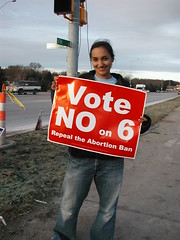
jen - e-day visibility (brookings)
Election Day Morning Visibility, Brookings, SD
Background: I spent the 5 days leading up to The Big E-day (election day, Nov 7th) in Sioux Falls, South Dakota (and Brookings, SD, and Watertown, SD), volunteering with the Campaign for Healthy Families. PPFA/PP Action Fund paid for my plane ticket, hotel room, and food in exchange for my volunteering 5 days of my time to work against Referred Law 6, the abortion ban signed into law by SD Gov. Mike Rounds (who was, incidentally, somehow re-elected this year) last March. See, instead of PP challenging the ban in courts, as the legislators and governor had hoped and prepared for in hopes of overturning Roe, the SD Campaign for Healthy Families collected signatures and put the ban on the ballot for the voters to decide on. Which meant that an extensive campaign was formed to overturn the ban, which is where PPFA (and the ACLU, who also sent a ton of people) came in.
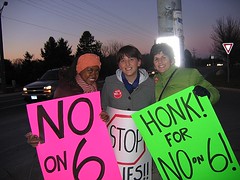
jamia christine gretchen - visibility 11-3
Jamia (from DC), Christine (native South Dakotan), and Gretchen (from New Haven, CT) - a few of the many incredible people working against Referred Law 6.

It was intense, and moving, and frightening, and life-changingly incredible. And, most importantly, WE WON (and yes, that is me in that picture, second from the left. score for me and Jamia, the two darkest people at the election night party in Sioux Falls. nothing like tokenism to gain you some fame.) I met incredible people, and I was actually doing things, things that mattered, instead of reading about doing things like I've done for the past 3 1/2 years while stuck in academia.

But there was something about the fight/success in South Dakota that never quite sat well with me.
South Dakota's demographics necessitated a strategy that I would not have chosen. SD is a red state. It helped George W get "elected" the first time around, and re-elected the second time. To make generalizations that are supported by polling numbers: they dislike gays (they were one of 7 states who passed the gay marriage bans this election), they don't like dark people (I was about as dark as tolerable, as was made perfectly clear while canvassing with Jamia, the only black person I saw in all of Brookings, where we were stationed most of the week), they don't particularly like women, and they're big on military and while they're split on the Iraq war, in the polls, most South Dakotans approve of it and the job Bushie is doing. In short, South Dakota isn't exactly the kind of bastion of liberalism (except in the traditional sense) that I would feel very comfortable in.
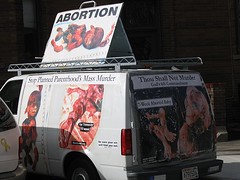
fetus truck
As a visual aid, there were a few of these scattered around the state in the days leading up to the election, with little resistance from South Dakotans.
The SDCHF and PPFA/PP of North Dakota-South Dakota-Minnesota conducted polls early on to give them information to shape their campaign strategy.

The strategy they shaped, then, was one that worked. But not necessarily one I was so ok with, given my conscience.
The approach we had to use was one that focused solely on the lack of exceptions provided in the law. The way it was written, the only exception to the full ban on all abortions exists for women whose lives would be in imminent danger if they were to go through with the pregnancy. There were no exceptions for if a woman's "mere" health were in danger, or for if a woman was the victim of rape or incest. This lack of exceptions, according to the polling that was done, was where the majority of South Dakotans felt the law went too far. And so, that was the part of the law that we attacked.
Our spiel (as I spoke it for between 8-12 hours per day, with the slight Midwest accent that I quickly picked up):
Hi, this is Jen, from the Campaign for Healthy Families. We're just calling [coming by] today to remind you how important it is to get out to vote on Tuesday, and specifically, how important it is to vote No on Referred Law 6. That's the abortion ban that has no exceptions for victims of rape or incest, or for if a woman's health is in danger. This election is going to be very close, so we wanted to make sure that everyone voting No on Referred Law 6 gets out to the polls this Tuesday. Polls will be open from 7am-7pm and you can cast your ballot at ____.

That was the GOTV spiel, not the Voter ID/Persuasion spiel, but the Voter ID/Persuasion spiel still spoke specifically about the lack of exceptions, said that the law "went too far." Still created all these ideological problems for me.

By focusing so intensely and specifically on the lack of exceptions, we were able to persuade voters to vote our way - by a 56%-44% margin, actually. (Still too close for comfort, but still a 12-point margin.)
However, by focusing so intensely and specifically on this lack of exceptions, we also reinforced the hierarchy of circumstances and stigmas surrounding the choice of abortion. That is, we didn't challenge - reinforced, actually - the idea that it's ok to have an abortion if your pregnancy is the result of incest or rape, or if your health or life is in danger, but for other reasons, it's not so ok. If your partner's condom broke? Sucks to be you. If the Pill just didn't work? Too bad - you shouldn't have been having consensual sex anyway, if you weren't willing to take on the consequences of such actions. It makes pregnancy into a punishment. It makes the right to an abortion contingent on how you got to the place where you need that choice.
Which is ridiculous. Your control over your body doesn't decrease if your pregnancy was not the result of violence. Control over your body is control over your body. You can't qualify it.
But we had to, in order to win. If we'd gone in there with a message that my conscience would have been totally ok with, if we'd used the whole "my body, my choice" line, we would have easily had our asses handed to us and set up the overturning of Roe v Wade. We would have effectively lost the right to abortion for women throughout the country.

So we had to sacrifice our conscience, to a degree. We had to closet ourselves as "radical" pro-choicers who believe in the unqualified right to abortion and focus on qualifiers that were left out of the law.
We had to, in effect, strategize away our conscience for the good of the movement.


But when does it become ok to sacrifice the rights of some (in this case, women who were impregnated not through acts of violence or who didn't have life- or health-threatening pregnancies) in order to secure rights for others? When do these sacrifices become too much?

If you have to strategize away your conscience, how can you be ok with that strategy? If that's the only way you can get even minimal rights for women, does that make it ok? Is it worth it to put the rights of others aside to gain minimal basic rights for those that the majority will give rights to? Is strategic incrementalism really what the feminist movement should be embracing? Can we ignore the rights of some (even "temporarily") in favor of small gains for others (usually white, middle- or upper-class women)?


I know that as an activist, I'm not going to always be able to take the stands I feel comfortable taking because the situation is not always going to allow for it. I know that you can't be idealistic and pretend that the message you want to send will be warmly received in the majority of America. Because the fact remains that the majority of this country is not as pro-choice as I am. Doesn't believe that bodily integrity is a fundamental human right that should be extended to women. And while that's what we have to work toward changing, that's also what we have to work with.

In the comments on feministing recently, Amanda (of Pandagon said, wisely: "However, feminists have to work with the world we've got, not the one we want."
And I think I need to add to that. We have to work with what we've got, yes, but we also have to work toward what we want.

I wish more than anything that political strategy could work by being idealistic. By being all-inclusive all the time and by always employing good feminist, non-essentialist frameworks. And for a while, when I hadn't really left the liberal bastions of New York state and Northampton, Massachusetts, I thought that maybe it could. The people in my hometown, and especially the people here in Northampton, are actually pretty receptive to inclusive policy. But after being in Sioux Falls and Brookings, SD, and seeing "middle America," and actually finally experiencing people who may not think the way I do and may not have been raised the way I was...I've realized that can't happen. We can't have the perfect, all-inclusive strategy and actually be successful. We can work toward it, but we can't use it, not in the current political environment. Even with the huge gains the Dems, and women, and even queers (in AZ at least, kinda) made on November 7th this year, employing that kind of strategy would be asking to lose. Pushing the envelope is important. If you don't push the envelope, you don't get change. But over-pushing it causes severe backlash, and quite possibly sets you back further than you were when you started.


Something they don't teach you in school, even in women's studies or explicitly feminist academia, something incredibly disheartening:
In making and reading and analyzing theory, and even theorizing about political strategy, we can be inclusive and non-essentialist. We can be "good feminists."
But in strategizing and in political action, we can't be.


We've got to work toward the world we want, but we'll never get that world unless we work with the one we've got.

Labels: ,

Monday, July 31, 2006

on rape, disclosure, and relationships

I've been contemplating this post for a long time now, which of course means that things have become more, not less, convoluted. But let's see if I can make this somewhat coherent.


People talk a lot about the immediate damage that rape causes for the victim. You see it on TV shows (like my beloved Law & Order: SVU), you hear it talked about when the topic comes up in conversation (however rare that may be), and you read about it when news sources actually cover rape stories (again, a rarity).
You see the immediate effects: the tears, the pain, the complexities of the initial disclosure. Maybe you'll see or hear about these effects a month or two after. They have no qualms with showing that kind of damage. But past that, nothing. It's no longer worth covering or talking about when the pain isn't so fresh. But that, of course, doesn't mean that the pain is any less there.

I talked about this a little bit before, back in my post about the inaccuracy of the rhetoric of the "survivor" a few months back. About how you don't really "heal" or "get better."
I didn't really delve into how that inability to just "get past it" affects every other aspect of life, though.
Specifically, for the purposes of this post, how that plays into getting into/being in a relationship, and how that plays into intimate friendships.


I, personally, can't so much hide the fact that I've got...well, that I've got "a past." My left arm has about as much scar tissue as it has unscarred skin. (I'm right-handed, so my right arm is significantly clearer.) My upper thighs, too, are full of scars that scream "I'm not normal." But the deal-breaker, it seems, is the scar on my upper stomach, right below my bra line. The scar that just puts it right out there. The scar spells out the word "SLUT."
That scar reveals, in no uncertain terms, that I've been hurt, and that I'm not exactly "healed." Even if someone who I was interested in could somehow get past the plethora of scars on the more easily noticeable parts of my body, that one would (and has) scare(d) them off. Because who wants to be with someone who was (or, for all they know, still is) so unstable that she would brand herself as such?
Nobody.
At least, nobody who hasn't been through a similar situation herself. And even most of the people who have would rather be with someone "normal." (I know I would.)

And this is where things get tricky. Because once they've seen that scar, actual disclosure is somewhat unnecessary. Once they've seen that, they don't really want to know what it's about. And so you don't know how to have the "I was raped/abused/molested" conversation...since by that point, they've probably pretty well figured it out.
And of course, the point at which they figure it out is exactly the point when they decide that they don't want to deal with it. That you're too damaged for them to waste their time on anyway.

I know that sounds harsh. And I've had countless people tell me that I'm not "damaged goods," that I haven't actually ruined my chances of being in a relationship.
But really? It kind of has.

I remember, when I was reading Lucky (by Alice Sebold), she wrote something about how, as a rape victim, you're perpetually alone. It makes you so different from every other "normal" person out there that people don't really know how to handle you, and they don't really want to.

I wish that weren't the case. I wish that rape didn't have such lasting effects.
But I also wish that people would recognize those effects. That they would actually acknowledge that the damage that rape causes doesn't end after a few months, after the victim "should" be "over it."


This isn't all coming out of nowhere. These are the things you think about when you start seeing (and shortly thereafter stop seeing) one of the lucky, sheltered women whose past is practically perfect. These are the things I've been reading, the things that have hit me pretty hard in the posts I've read in the past couple Carnivals Against Sexual Violence. Like the Triggers & Speaking Up post at lelyons. Because there's just something about triggers and relationships and the combination of the two that never seems to get much attention.
And in a way, I understand why it doesn't get that attention. Because really, who wants to talk about that? It's so much easier to pretend that there aren't implications years later, so much less disconcerting to ignore the long-lasting effects. But it's still a completely inaccurate portrayal of the reality.

Yes, I'm sure there are people out there who do well, great even, in relationships with women who have abusive pasts. Mostly, though, these are people who understand because they have similar pasts themselves.
The women I've dated and the women I will date who have practically perfect pasts will never be able to understand where I'm coming from in life. They'll never get why I'll cut away every so often while we're having sex, and they'll never get why I can't just automatically trust that they won't hurt me. Sure, they might say that they "understand," and they might think that they do...but unless you've gone through this yourself, it's not something you can ever fully comprehend.

I shouldn't have to try to explain this to people, though. I shouldn't have to only date people with similar pasts just because the "normal" people won't understand. I shouldn't have to continue to deal with this, almost 8 years later.

And I know I do this a lot. I pull the "should" and "should not" thing, even though I know that "should/should not" really doesn't mean anything, and it's not something that I have any control over changing.

So to flip this into something a little more constructive, a little more plausible: I wish that people could comprehend just how deep the damage that rape causes goes. How long it lasts. How inescapable it is. Because even with all of this evidence, even with the huge numbers of victims, people still underestimate the damage and people still see it as a Not So Serious crime. And maybe that's because of our legal system that only recognizes it as such, or maybe it's because of the larger rape culture that surrounds us, but treating rape and sexual abuse as Not So Serious doesn't do anyone any favours...except, of course, the rapist.

Labels: ,

Tuesday, April 18, 2006

blogging against sexual violence #3

(The last...)


I have a problem with the fight against rape and sexual violence.
Don't get me wrong -- I loathe sexual violence, it needs to end, and we need to be vocal - hypervocal, even - about it before it ever will. I've done numerous final papers about the rape culture, how all the different things like race and class and sexuality (and so on) intersect with and work within the patriarchy in order to create the rape culture.
My problem doesn't lie in the ideology behind the fight. There, I'm behind you all the way.
My problem lies in the rhetoric employed in the fight.


Specifically, the rhetoric and model of "The Survivor."

In every anti-rape, anti-sexual-violence form of activism I've been a part of, the message (apart from "good god, let go of the rape culture already and let us control our own bodies") has been centered around "Healing" and "dealing with it" (but never really "getting over it") and mostly, about crossing that line from "victim" to "survivor."

The thing is, the dichotomy of "victimhood" and being a "survivor" is absolutely false. Many, many people who have been victims of sexual violence go their whole lives with one foot in both worlds, stuck in between and never fully fitting into either category. Some people might never get to that place of "survival" at all, and will never be able to "heal" or "deal with it" in any meaningful sense. Like me.

There are lots and lots of reasons that I know I will never reach that place of calling myself or being a "survivor," which I won't go into here. Some of them are entrenched in the rape culture that makes me blame myself for my abuse and my rape(s), but some of them are simply because I don't have that capacity to "heal." You might be thinking, "Oh, don't be silly, you're only 20 years old, you don't know what you can heal from yet," and maybe, just maybe, you're right. But you're probably not. But that's exactly the problem I have with this fight against sexual violence. There's always the assumption that everyone can heal. That someday, if you just work hard enough at it, you, too, will be able to be a "survivor."

I reject that notion. It's simply not true.
But more, I reject the entire model of "The Survivor" as the universal model for all victims of rape/sexual violence. No (or almost no) victim's experience of sexual violence is identical. So why should the form that their recovery (or lack thereof) takes be the same?


I know, I know. Nobody wants to hear the story about the girl who was victimized for 7 years of her childhood and never got over it. They want to hear about the girl who was abused, but went on to win the Nobel Peace Prize for her work with children in Uganda. And while that girl who went on to win the Nobel Peace Prize is no doubt extraordinary and amazing, that's not every victim's story. That's not how everyone's story ends. But just because my story, or four hundred other women's stories, don't end in sunshine and rainbows and the extraordinary (sometimes out-of-reach) achievement of overcoming one's victimization, that doesn't mean that those stories are any less worthwhile, any less valid. Our stories need to be told too.

Yes, thinking that you can get over this and you can "heal" is vital for recent victims of sexual violence. But not at the expense of alienating those who don't fit that model, of ignoring their stories of non-recovery.


------------
So, with that, here's my story of non-survival:
I was abused by my brother from the time I was 6 or 7 until I was 13. I told nobody until I was 15. My mother walked in on us once when I was 9. She had a talk with me, told me, "don't tease your brother. Boys can't always control themselves." When I first told, I was in the hospital after telling someone I was slightly suicidal. The hospital would not discharge me if my brother were still at home, so my parents (my mom, begrudgingly) sent him out to live in San Diego, where my other brother was. I spent the rest of high school pretty much going from boyfriend to boyfriend, but not attaching myself to anyone, and never letting any of them in, really. I gave one boyfriend a blow job a few times, and he reciprocated each time. I never orgasmed.
I didn't orgasm until I was 19, the first time I was with a woman. Even then, we had sex three or four times, and I only orgasmed once.
I started cutting when I was 13. I still haven't stopped. I bruise, too, and burn sometimes. Occasionally, I go through cycles of disordered eating (but really, it's not an eating disorder), sometimes lasting a day, sometimes two months. I still think about suicide, in the abstract, even though I'd never do it.
I can't say no, even when I want to, especially to a woman. To men, it's slightly different, but it's not like they listen anyway. This past summer, I got drunk at a friend's party and ended up in a threesome situation with one woman and one man. He was sober. We were not. We both went down on him. I said I didn't want to once or twice, but never really assertively.
At a new year's party this year, I was raped by a boy I've known since preschool. Again, I was far more intoxicated than I should have gotten. It was a threesome situation, and I was into the girl, but not him. Somehow, he ended up inside of me even though I said over and over that I was gay, that I didn't want to, and once he already was, I said that I was done with the hetero part, that I wanted him to stop. He didn't. I told nobody until last week. I told my best friend, who had been trained as a rape advocate/educator. She asked me if I'd made it worse in my mind since January. She told me not to think so much about it, that "it was just an accident."
I can hardly function as a student. I've had to ask for extensions on most of my work this semester, and have to go talk to my class dean on Thursday about taking incompletes and/or getting extensions for my final papers past finals week. Not a day, hardly an hour, goes by that I don't think about my brother, or the boy this summer, or the boy I've known from preschool.


So, no, I'm not ok. And no, I probably never will be. But at least this story is authentic. At least with this story, there is no happy ending.

Labels: ,

blogging against sexual violence #2

A poem, this time (spoken word -- think Alix Olson style), that i read/performed at the TBTN speakout:


because see now, there's this demon that
rises up inside
rises up from the semen you
left inside
this demon that calls me stupid
calls me dirty
calls me useless

and usually...i agree w/ him
usually, he's got me pinned to a T
because this demon you made,
this semen you left --
makes me all of these things
makes me a whore
makes me a slut -
makes me your slut.

and maybe, you own me now
maybe you own me now
from the vagina you penetrated
to the breasts you violated, but....

but what?
there is no "but"
there's no revival
there's no renewal
there's no "survival."
there's no "getting over," no "getting past"
this thing you left behind

because this will always be with me
and you will always be with me


Like
when i stare into her face -
i stare into yours
and when i'm kissing her -
i'm kissing you/you're kissing her
and when she makes me come -
you make me come
you seep out of me
you seep onto her
you've. contaminated. me.
you've. contaminated. her.


and recovery? is a lie
survival? is a myth
the only thing that survives is
you
polluting
this.

Labels: ,